CBSE Class 10 Social Science Question Paper 2026 (Set-2) – Complete Analysis
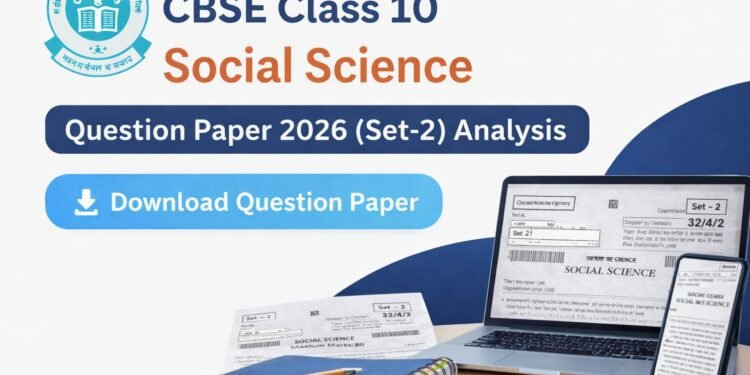
If you are preparing for the CBSE Class 10 Board Exam, practicing real question papers is one of the best ways to score high marks. In this article, we provide a detailed overview and analysis of the CBSE Class 10 Social Science Question Paper (Set-2) along with exam pattern, question types, and preparation tips.
This guide will help students understand the paper structure, marking scheme, and important topics asked in the exam.
Students can also review the original question paper here:
CBSE Class 10 Social Science Exam Pattern 2026
According to the uploaded question paper, the maximum marks are 80 and the exam duration is 3 hours. The paper includes different types of questions to test conceptual understanding and analytical ability.
From the instructions visible on page 1 of the question paper, the exam contains 37 questions including map-based questions.
CBSE Class 10 Social Science Exam Pattern 2026
Section A – Multiple Choice Questions
The first section contains 20 objective questions from History, Geography, Political Science, and Economics.
Examples from the paper include:
Example MCQ Topics
Globalization and digital technology
Development indicators
Sectors of the Indian economy
Political parties and democracy
Mineral resources
One question in the paper asks about the impact of digital technology on globalization, where communication improvements play a major role. This question appears on page 5 of the paper.
social science paper
Another question asks students to identify the basis used in the World Bank development report, which includes per capita income as a major indicator.
social science paper
These questions test conceptual clarity rather than rote learning.s leo.
Section B – Very Short Answer Questions
This section contains 4 questions worth 2 marks each.
Example topics include:
Resource planning in India
Feminist movements
Public facilities
Trade networks
For example, one question asks why the Indian subcontinent was important for trade networks before European arrival. This question appears in the short-answer section of the paper.
social science paper
Students are expected to answer these questions in about 30–40 words.
Section C – Short Answer Questions
Section C includes 5 questions carrying 3 marks each.
Typical topics asked:
History
French Revolution and nationalism
Nationalist tensions in the Balkans
Geography
Agriculture and crop production
Government measures to improve agriculture
Economics
Economic reforms after 1991
Role of credit in the economy
Students must write 3–4 clear points to get full marks.
s leo.
Section D – Long Answer Questions
This section carries 5 marks for each question, requiring detailed explanations.
Some major topics include:
1. Role of Gandhiji in the Non-Cooperation Movement
Students must explain how Gandhi mobilized people and united various social groups during the freedom struggle.
2. Sustainable Ways to Meet Energy Demand
Students must discuss renewable energy sources such as:
Solar energy
Wind energy
Hydropower
Biogas
3. Democracy and Development
This question asks students to explain the relationship between democracy and economic development.
4. Differences Between Formal and Informal Credit
Students must explain how banks differ from moneylenders in terms of interest rate, rules, and accessibility.
These questions require structured answers with explanations and examples.
nge this text. Lorem ipsum dolor sit amet, consectetur adipiscing elit. Ut elit tellus, luctus nec ullamcorper mattis, pulvinar dapibus leo.
Section E – Case-Based Questions
Case study questions are designed to test analytical and reading skills.
One case study in the paper discusses Local Self Government and the structure of Panchayati Raj institutions.
The passage explains how:
Panchayats operate at village level
Zila Parishad works at district level
Municipal corporations manage urban governance
Students must read the passage and answer related questions based on it.
Another case study focuses on New Forms of Publication and Print Culture, highlighting how printing technology influenced society and culture in India.
Section F – Map-Based Question
The last section includes a map question worth 5 marks.
Students are asked to locate or identify places such as:
National movement centers
Mineral locations
Major ports or power plants
Map questions are very scoring if students practice NCERT maps regularly.
Important Topics from the Paper
After analyzing the question paper, the following chapters appear important for preparation:
History
Nationalism in Europe
Print Culture and the Modern World
Nationalism in India
Geography
Resources and Development
Agriculture
Minerals and Energy Resources
Political Science
Federalism
Gender, Religion, and Caste
Political Parties
Economics
Development
Sectors of the Indian Economy
Globalisation
Students should revise these chapters carefully before exams.
Preparation Tips for Class 10 Social Science
Here are some useful tips to score high marks in Social Science:
1. Focus on NCERT Books
Most questions in CBSE exams come directly from NCERT textbooks.
2. Practice Previous Year Papers
Solving past papers improves:
Time management
Question understanding
Answer writing skills
3. Use Maps and Diagrams
Maps help you score easy marks in Geography questions.
4. Write Point-Wise Answers
Avoid long paragraphs. Write answers in clear bullet points.
5. Revise Important Dates and Terms
Especially for History and Civics chapters.
Why Students Should Solve This Paper
Practicing this question paper helps students:
Understand the CBSE exam pattern
Identify important chapters
Improve answer writing speed
Build confidence before board exams
This paper is also useful for students preparing for school pre-board exams.
FAQs
1. How many questions are in the CBSE Class 10 Social Science paper?
There are 37 questions in total including map questions.
social science paper
2. What is the maximum mark for the exam?
The exam carries 80 marks.
3. How many sections are there in the paper?
There are six sections (A to F).
4. How many MCQs are asked?
There are 20 multiple choice questions.
5. Is there a map question in the exam?
Yes, the map question carries 5 marks.
6. Which book is best for preparation?
The NCERT Social Science textbook is the most important.
7. How many long answer questions are asked?
There are 4 long answer questions worth 5 marks each.
8. Are case study questions included?
Yes, case-based questions are included in Section E.
9. How much time is given for the exam?
Students get 3 hours to complete the paper.
10. Where can I download the question paper?
You can download the original paper from the link above in this article.